
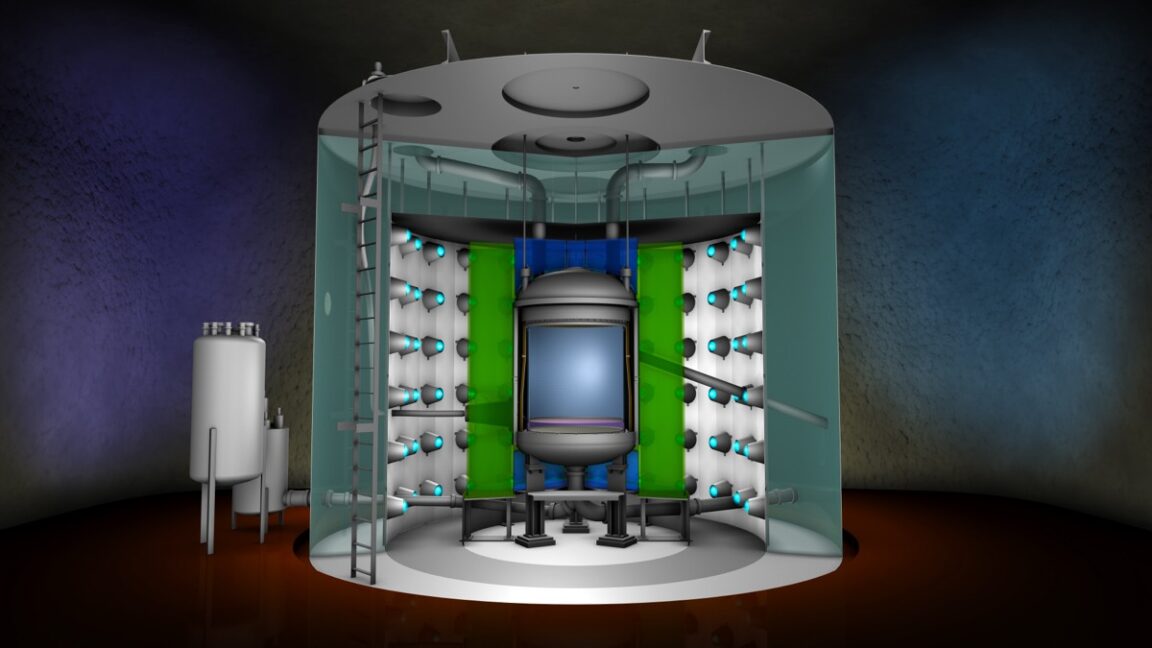
Ars Technica has published its monthly roundup of significant scientific developments that might have otherwise gone unnoticed. The September edition highlights several major breakthroughs, most notably a potential hint of dark matter detected by the LUX-ZEPLIN experiment in South Dakota. While the researchers emphasize that the signal is preliminary and could be a statistical anomaly, it remains a significant point of interest for the physics community. Other featured stories include the observation of entangled Z bosons at the Large Hadron Collider, investigations into the potential use of psychoactive substances during the Late Pleistocene, and a technical analysis of a telescope historically attributed to Galileo. These stories underscore the ongoing efforts in particle physics and historical research, as teams continue to gather data to confirm these tantalizing, yet unverified, scientific findings.
This is a summary. Read the full article at the original source:
Ars TechnicaRelated stories

The latest edition of the Rocket Report highlights a significant milestone for SpaceX, as the company successfully completed the first orbital launch…

IEEE Spectrum is hosting a webinar featuring Dr. Pavel Terekhov from the National Institute of Standards and Technology, focusing on the design and si…

A long-standing mystery regarding Venus' yellowish 'lower haze' has finally been solved. First observed by Venera and Pioneer Venus probes in the 1970…