
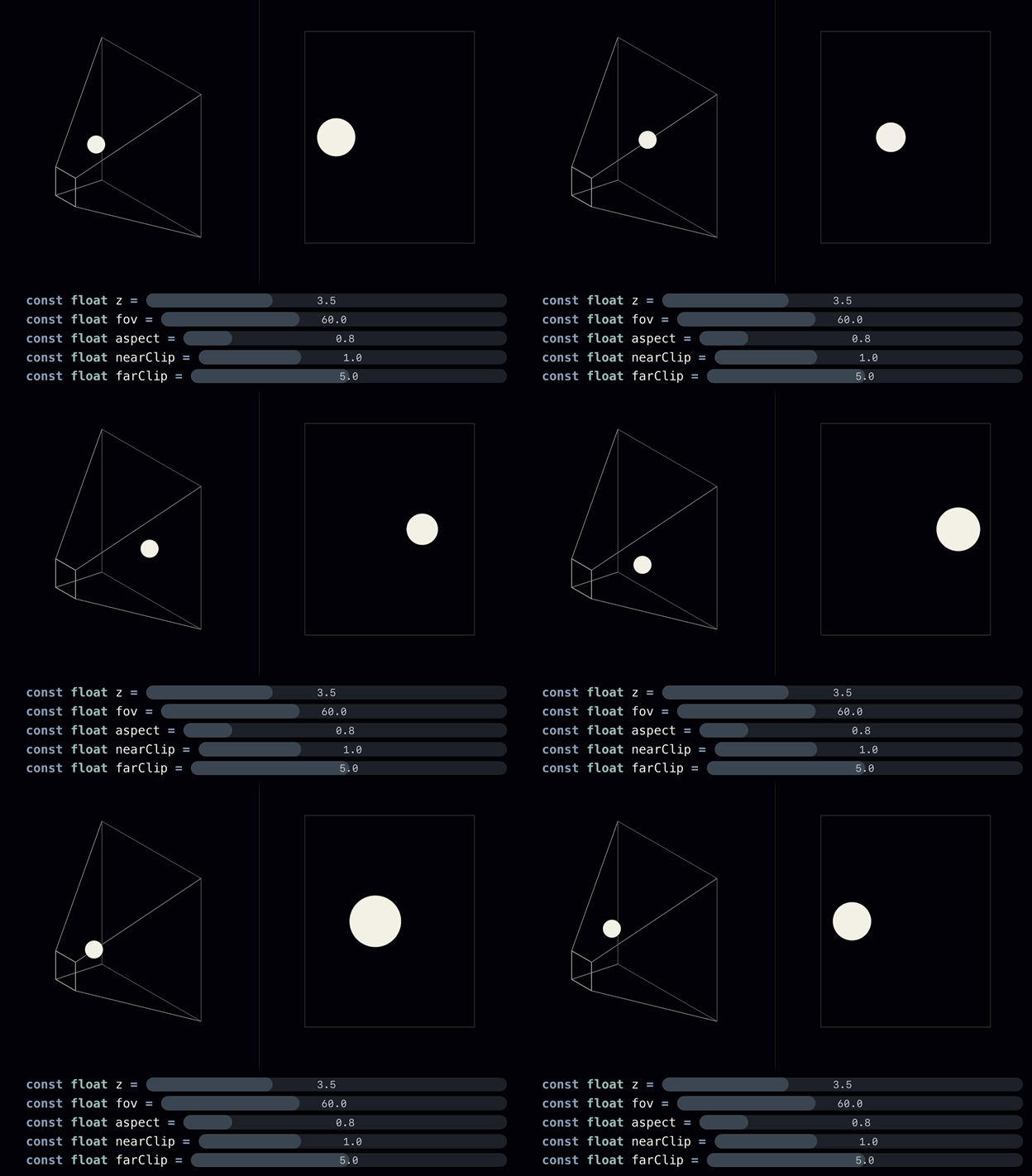
In a recent technical deep dive, Gabriel O'Connor explores a simplified mathematical approach to achieving 3D perspective effects in software rendering. The article focuses on the technique of dividing coordinates by depth to project 3D points onto a 2D plane, a fundamental concept in computer graphics. By breaking down the linear algebra behind perspective projection, O'Connor demonstrates how developers can implement efficient 3D rendering engines without relying on complex external libraries. The post provides clear code examples and explains the underlying geometry, making it an accessible resource for developers interested in graphics programming. This method highlights the power of basic arithmetic in creating immersive visual experiences, proving that high-performance 3D effects can be achieved with minimal overhead. The article serves as a practical guide for those looking to understand the core mechanics of how modern rendering pipelines handle spatial data and depth perception.
This is a summary. Read the full article at the original source:
Hacker News (YC)Related stories

The code was never the point: Hacktoberfest, AI, and the value of the climb
Hacktoberfest has officially moved away from counting pull requests, signaling a shift in how the open-source community values contributions in the ag…

Understanding Claude Code Hooks: Why Exiting 1 Fails to Block Commands
A recent technical guide highlights a common misconception regarding Claude Code hooks: exiting with a status of 1 does not actually block command exe…

Six CLAUDE.md files, six codewords: three at launch, two after a Read, one behind an env var
A recent technical investigation by Rulestack explores how Claude Code handles CLAUDE.md files across different directory structures. By placing uniqu…