
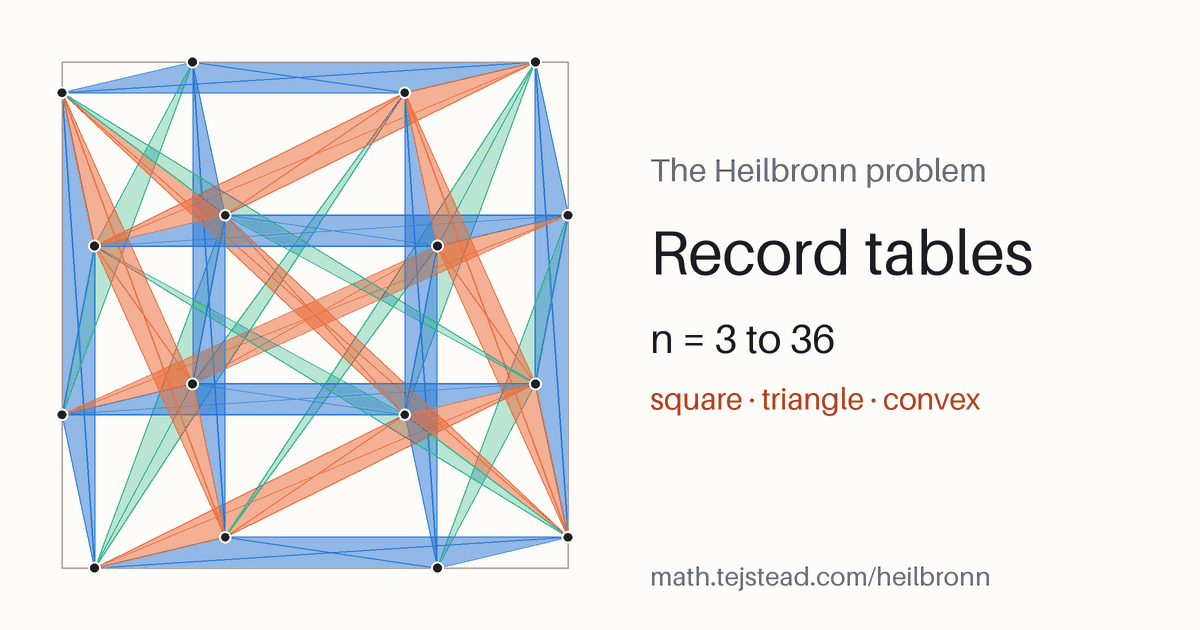
The Heilbronn Problem is a classic challenge in discrete geometry that asks for the smallest possible area of the largest triangle formed by a set of n points placed within a unit square. Proposed by Hans Heilbronn in the 1940s, the problem seeks to determine the distribution of points that maximizes the minimum area of any triangle formed by a triplet of those points. While it appears simple, it has proven to be notoriously difficult to solve for large values of n. Recent mathematical research continues to refine the upper and lower bounds of this problem, bridging connections between geometry, number theory, and combinatorics. This article explores the historical context of the problem, the various mathematical approaches used to tackle it over the decades, and the current state of research regarding its asymptotic behavior, providing a comprehensive overview for those interested in theoretical mathematics and geometric optimization.
This is a summary. Read the full article at the original source:
Hacker News (YC)Related stories

National Geographic has released a new seven-episode documentary series titled 'Africa: Earth's Wild Home,' which aims to explore the continent's dive…

A global network of particle detectors is providing unprecedented insights into the Earth's interior by measuring geoneutrinos. These elusive subatomi…

This article from Habr explores the accuracy of our knowledge regarding stellar systems closest to the Sun. The author notes that common perceptions o…