
GPT-6, Astra, Looped Transformers, and Hidden Reasoning
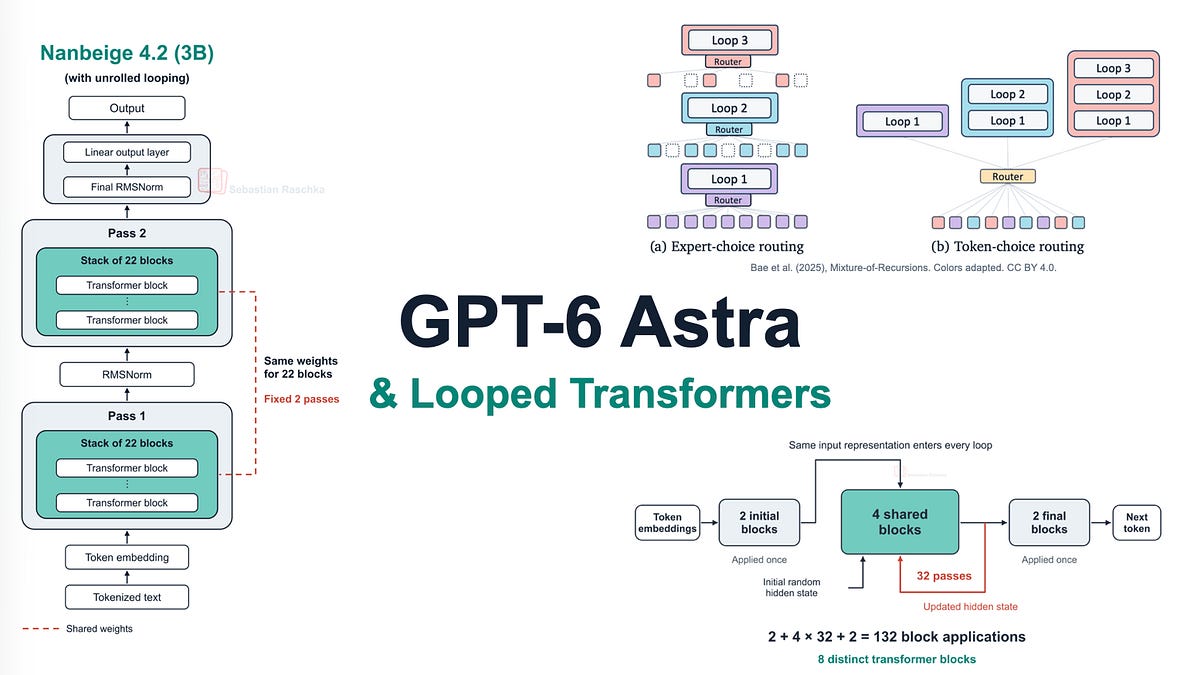
In a recent deep dive, Sebastian Raschka explores the evolving landscape of large language models, focusing on the architectural innovations shaping the next generation of AI. The article examines the concept of 'looped transformers,' which aim to improve efficiency and reasoning capabilities by allowing models to process information iteratively rather than in a single pass. Raschka discusses the implications of these advancements for future iterations like GPT-6 and Google's Astra project, highlighting how hidden reasoning steps can significantly enhance model performance on complex tasks. By moving beyond standard feed-forward architectures, these developments suggest a shift toward more autonomous and cognitively capable systems. The analysis provides a technical perspective on how researchers are overcoming current limitations in context window management and logical deduction, offering a glimpse into the future of generative AI research and its potential to bridge the gap between current LLMs and more advanced, reasoning-heavy architectures.
This is a summary. Read the full article at the original source:
Hacker News (YC)Related stories

Anthropic researchers warn of potential AI-driven human extinction by 2030
Three researchers from AI firm Anthropic have issued grave warnings regarding the existential risks posed by artificial intelligence. Jacob Coxon, who…

The viral AI assistant Instinct has introduced a new email integration feature, allowing the agent to function more autonomously on behalf of its user…

Shipt becomes the latest delivery app with an AI shopping assistant
Delivery platform Shipt has introduced a new AI-powered shopping assistant designed to streamline the grocery ordering process for its users. The tool…